
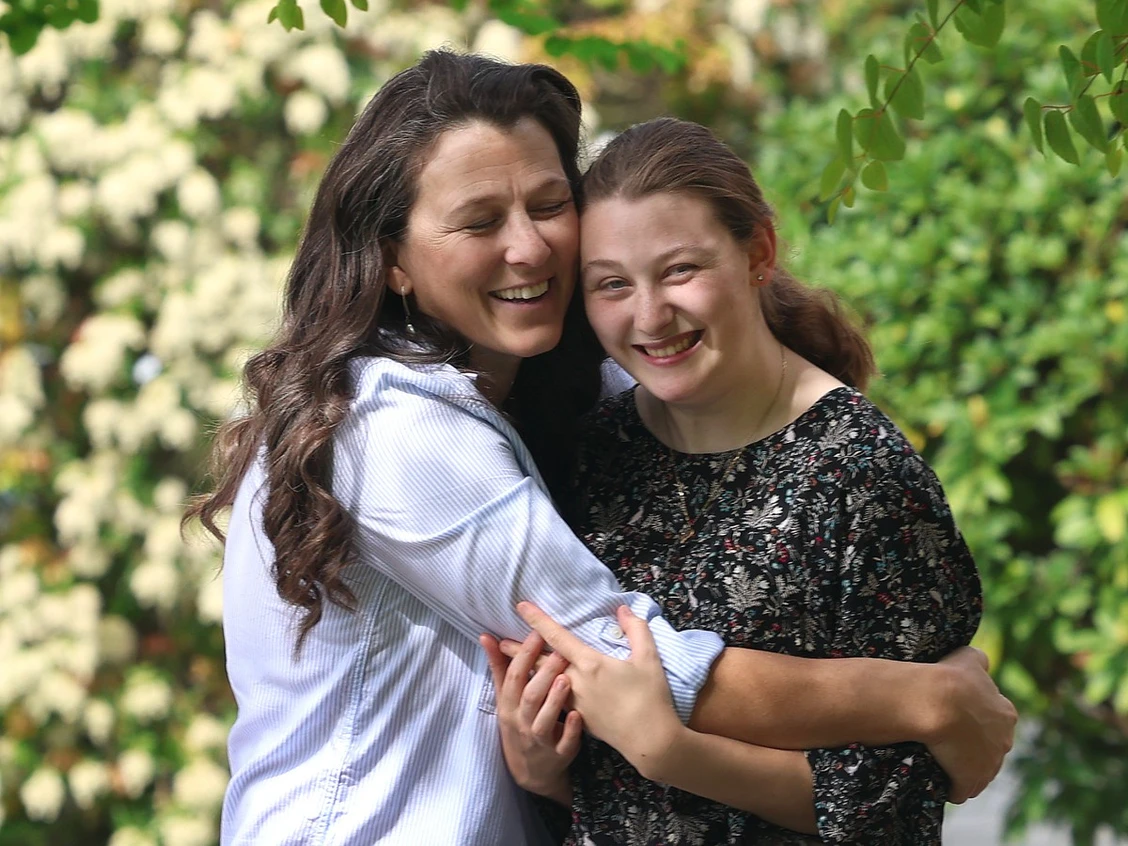
Sue Hargrave gave all she had to her daugher to help her overcome severe challenges. She’s also the force behind The Traverse, private housing units for individuals with developmental disabilities.
It’s exciting being 19. The future glimmers before you, a landscape of limitless possibilities.
Whistler resident Eliza Hargrave is looking forward to the things most 19-year-olds look forward to: continuing her education, traveling, living on her own. Her mom, Sue Hargrave, wants all those things for Eliza. However, for Eliza, these things aren’t eventualities … they’re challenges.
But thanks to a mother’s extraordinary perseverance, many of Eliza’s dreams are now within reach.
When Eliza was born, her mother was told her baby girl would never talk, let alone walk. Sue, being a woman of considerable flint, set out to ensure that, despite Eliza’s challenges, she would be given every opportunity to live as full a life as possible.
That last line is so blithe: bad news delivered, plucky fortitude mustered. If only it were that easy. Sue’s heart broke when she learned that her precious baby girl had a lifetime of difficulties ahead of her. But motherhood is the tinder of miracles. Mothers move mountains when they have to. So, Sue moved a mountain. Her mission was to give her little girl the tools to live a fulfilling life.
Sue plunged into every early intervention program offered by B.C.’s Centre For Ability. She was convinced that the earlier the intervention, the greater Eliza’s chance for advancement. Therapy of every description was part of every single day. Eliza was non-verbal until age four, so Sue, along with Eliza, learned sign language. This steady application of exposure and repetition eventually got Eliza over several hurdles. Those efforts have been maintained, and the results have been astonishing.
The very good news is that Eliza has thrived. In fact, her challenges aren’t immediately evident. If you were to meet Eliza today, what you would notice is her heart-shaped face and quick smile. She is a charming conversationalist, and will want to know all about you. As for walking and talking, well, she walks and talks just as well as you or I.
So much for dire prognostications.
There are, however, other hurdles ahead.
Sue worries about Eliza’s future. She has all the worries that any parent has, but Sue’s worries are more complex. Eliza will require assistance all her life — assistance that would preclude her ever living completely on her own. Sue worries about how Eliza will manage when Sue is no longer able to provide that assistance. It’s a worry that keeps her up at night. If you’re a parent, I’m sure you can imagine.
I bet in your lifetime you’ve lived in several different homes. People with developmental disabilities, however, usually make only one move in their lifetime — from home to an assisted-living facility. When parents are unable to provide the necessary assistance their adult child requires, what options exist? Sue tells me that people living with a disability have about $500 per month allocated for rent. But making rent isn’t even half the problem. How do you go from living with people who understand and care for you to managing everything alone?
Realizing this issue was in their future, Sue, along with other parents of developmentally challenged kids, set to work back in 2019 to create the Whistler Independent Supported Housing (WISH) society. Despite being a recreational hub, Whistler is like any other community, with a small cohort requiring special assistance. But it’s different in that it has scant appropriate services available.
In 2023, WISH achieved charitable status, which allowed them to move closer to their objective of creating an assisted-living facility centrally located in the Whistler area. In 2025, WISH achieved something quite astonishing. Whistler Legacy Sports, a byproduct of the Vancouver Olympic Committee, committed 10 self-contained, private housing units for individuals with developmental disabilities at The Traverse, a new Whistler housing facility completing in the summer of 2028. Not having to relocate means the world to people for whom familiarity means so very much.
Currently, Eliza is in her final year at Whistler Secondary. Next year, she ages out of the Ministry of Children and Family Development’s care and into Community Living B.C., the provincial Crown corporation that funds support for people 19 years or older with developmental disabilities.
Starting next year, Eliza will be with Sue, “all day, every day”.
This is hardly ideal on either side of the equation, but Sue can accommodate it — her husband is retired and Sue’s work as a ski instructor with the Whistler Adaptive Sports Program is flexible. Other parents, however, aren’t so lucky. But they’re making progress. The hurdles are still there, but now a path forward has appeared.
So, Eliza is excited. And so is Sue. They can look forward to what comes next.
After all, Eliza is 19, and now there’s a future that truly beckons.
Jane Macdougall is a freelance writer and former National Post columnist who lives in Vancouver. She writes The Bookless Club every Saturday online and in The Vancouver Sun. For more of what Jane’s up to, check out her website, janemacdougall.com